The model
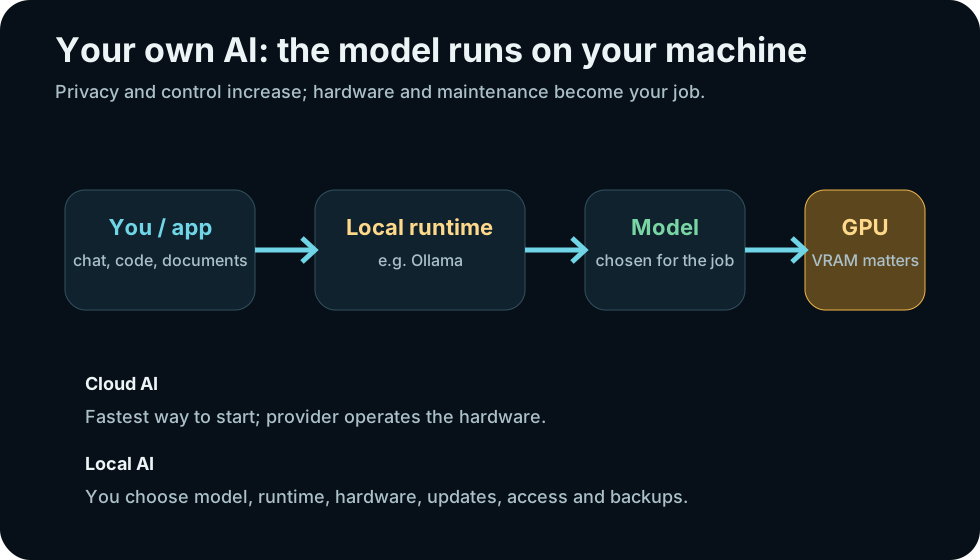
The trained neural network. Models vary in size, capability, licence, context length and resource needs. “Bigger” is not automatically “better for your task”.
A local model gives you more control over where inference happens and how it is integrated. In return, model choice, GPU memory, software updates, access control, performance and backups become your responsibility.
The trained neural network. Models vary in size, capability, licence, context length and resource needs. “Bigger” is not automatically “better for your task”.
Software that loads and serves the model. A tool such as Ollama can run supported models locally and expose an API for local applications.
GPU VRAM strongly influences what model sizes and context workloads are practical. CPU and system RAM also matter, but local AI planning should begin with the actual workload rather than buying a card by model number alone.
A chat UI, coding assistant, document tool or your own software calls the runtime. Local inference does not automatically make the surrounding application secure.
You need inference on hardware you control and have assessed where the data, logs and application state live.
A predictable local workload may justify hardware and operational cost compared with repeated hosted inference.
You want direct control over models, quantization, system prompts, local APIs or integrations without depending entirely on a hosted service.