Separate kinds of statements
Ask the AI to distinguish observed facts, inferences, assumptions and proposals. That makes review much easier.
Once the task depends on your situation, the quality of the answer depends on the quality and authority of the context you supply.
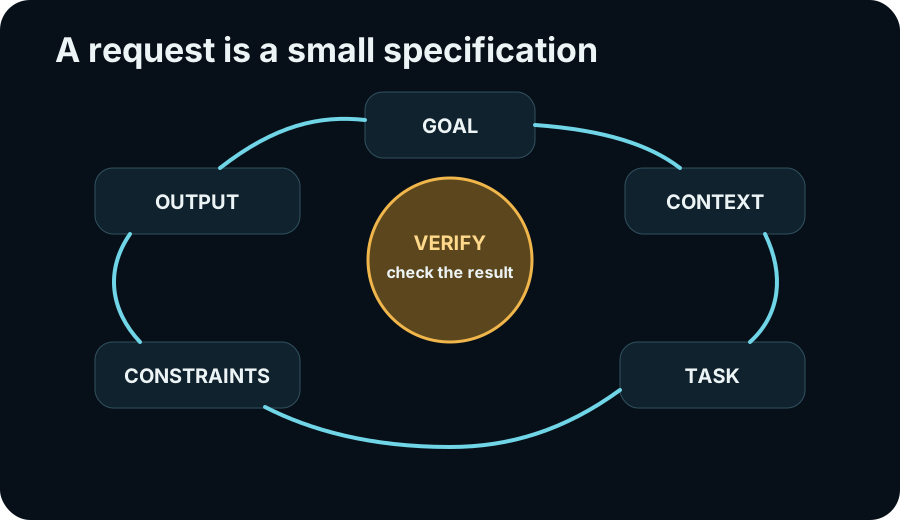
GOAL
What outcome are we trying to achieve, and why?

CONTEXT
What facts, rules, prior decisions, terminology or audience details does the AI need?

AUTHORITY
If sources conflict, which source wins?

TASK
What exact work should the AI perform?

CONSTRAINTS
What may it change? What must it preserve? What must it not assume?

OUTPUT
What form should the result take?

VERIFICATION
How will we know it is correct? What should be flagged as uncertain?
Ask the AI to distinguish observed facts, inferences, assumptions and proposals. That makes review much easier.
Say “Do not silently invent missing values. If a material fact is missing, identify it.” This is far safer than allowing plausible filler.
Goal: review this system without accidentally redesigning it. Authority order: 1. current instruction 2. locked decisions 3. design documentation 4. configuration/schema 5. existing code Task: identify where the implementation conflicts with higher-authority design. Rules: do not treat existing behavior as intended merely because it exists. Separate definite conflicts from open questions. Prefer root-cause mechanisms over special-case patches. Output: findings by severity, each with evidence, affected area, root cause and recommended correction. Verification: cite the exact source used for every design claim.Level 3: files and data →