1. A conversational engine
You can ask questions in ordinary language, refine the answer, ask for alternatives and challenge assumptions. The conversation itself becomes working context.
Modern generative AI is best thought of as a powerful pattern-and-language engine. It can explain, transform, compare, draft, reason through many problems and operate tools when connected to them — but it is not an oracle and it does not automatically know your private context.
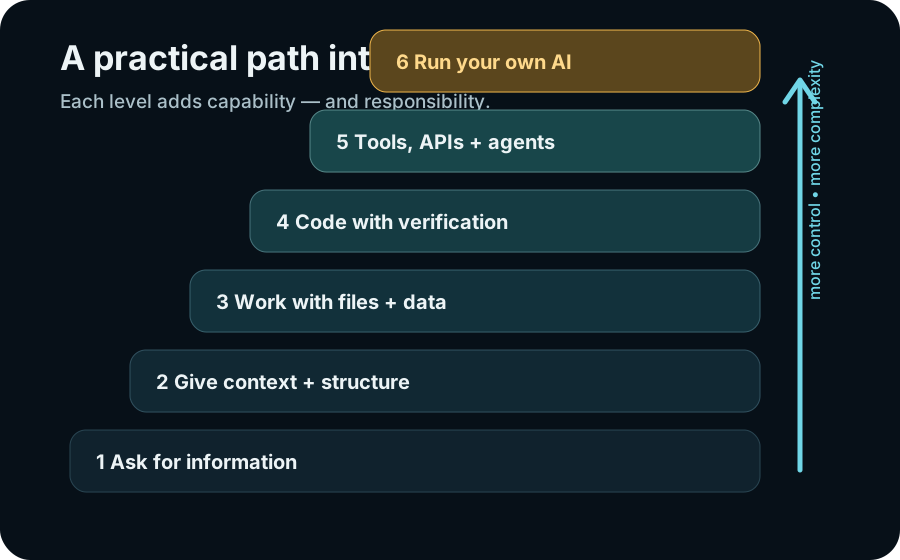
You can ask questions in ordinary language, refine the answer, ask for alternatives and challenge assumptions. The conversation itself becomes working context.
Give it material and ask for a transformation: summarize, explain, classify, rewrite, compare, extract structure, generate examples or critique an argument.
When software grants it tools, AI can search, read files, call APIs or perform bounded actions. The tool permissions — not the AI's confidence — define what it can really access.
AI is useful when the task benefits from language understanding, synthesis, iteration or pattern recognition. Typical examples include learning an unfamiliar subject, brainstorming, writing and editing, converting messy notes into structure, reviewing code, producing test cases and exploring several approaches quickly.
An AI may produce a fluent answer that is wrong, outdated, incomplete or based on an assumption you never intended. It can also misunderstand a local abbreviation, private project rule or unstated goal.
You do not need a GPU, an API key or programming knowledge to learn useful AI habits. Start with a mainstream hosted assistant and practise the interaction.
“Explain compound interest without assuming I know finance.”
“Compare these three options. Tell me what information is missing before recommending one.”
“Here are my rough notes. Organize them into a clear one-page briefing.”
Tell it what you are trying to achieve, what you already know, what constraints matter and what form the answer should take. Then ask it to identify uncertainty rather than filling gaps silently.
That is the subject of the next page →