Goal
What outcome are you actually trying to achieve? Give the reason, not only the immediate action.
You do not need magic words. You need to make the job legible: what you want, what the AI needs to know, what it must do, what it must not assume, what the output should look like, and how success will be checked.
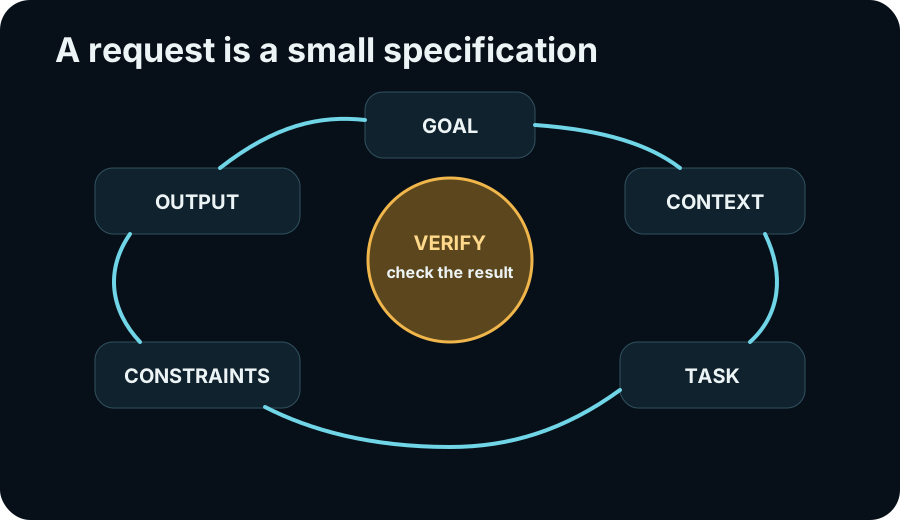
What outcome are you actually trying to achieve? Give the reason, not only the immediate action.
Supply private facts, project rules, source material, audience, prior decisions and terminology the AI cannot safely infer.
State the concrete work: analyze, compare, rewrite, design, debug, research, extract, plan or review.
Define boundaries: scope, length, authority, technologies, files allowed, time horizon, style or things it must not change.
Say what a useful answer looks like: decision table, brief, draft, step sequence, test plan, code review or prioritized list.
Tell the AI how to treat uncertainty and what proof you require: sources, tests, file inspection, calculations or a real run.
Make my website better.
The AI has to guess the audience, problem, technology, scope, tone and definition of “better”.
Goal: make this small personal AI guide easier for beginners to navigate.

Context: it is a static website hosted on WAMP. It must remain portable and require no build system.

Task: review the page structure and navigation, then propose the smallest changes that improve comprehension.

Constraints: preserve the existing dark visual style; no framework; no analytics; do not rewrite valid content unnecessarily.

Output: list issues by severity, then give a patch plan.

Verification: distinguish observed issues from preferences. Do not claim a fix is complete until the rendered pages have been checked.
More words do not automatically mean more clarity. Good context is the minimum information required to avoid the wrong assumptions.
“The customer is a retired engineer, already understands networking, and wants a local solution because the documents cannot leave the office.”
That changes the right explanation and likely architecture.
Pages of irrelevant history, duplicated instructions and contradictory requirements make it harder to identify what is authoritative.
Structure the context and make authority explicit when several sources disagree.
In real projects, AI may see requirements, old documentation, configuration and existing code that disagree. Tell it which source wins. A typical order might be: current instruction → locked decisions → design documentation → configuration/schema → existing implementation. This prevents the AI from treating an accidental implementation as the intended design.